
Tea lot change control keeps a caffeine specification tied to its evidence
A caffeine result can be useful to a tea buyer only when the buyer can tell which lot, format and preparation it represents. That is the operational question behind tea lot change control: when a material, pack format or preparation condition changes, decide whether the existing caffeine evidence still answers the current buying question. For importers, beverage teams and private-label tea managers, this is a practical records-and-decision system, not a promise that every lot will give an identical number.
The 2025 peer-reviewed infusion study cited in this article’s source ledger found that tea type, temperature, time and serving form influenced measured caffeine in the samples studied. That result is a reason to preserve the context of a test; it is not a universal product specification or a substitute for a product-specific laboratory result.
Start with the claim or decision, not a test request
Before asking a B2B tea supplier or laboratory for a caffeine test, write one sentence describing the decision the result must support. Examples include screening a candidate ingredient, comparing two approved lots under one brew protocol, qualifying a concentrate for a beverage trial, or checking whether a changed tea-bag construction needs a new evaluation. A request that simply says “test caffeine” leaves the result detached from its intended use.
Record the material identity, lot code, product form, target market, intended beverage format and decision owner. Then state the reporting basis: dry material, prepared infusion, concentrate or finished beverage. These are different objects. A result on dry leaf should not be silently converted into a serving statement, and a result on a laboratory infusion should not be treated as a result for a bottled drink without a defined conversion and suitable validation.
Build a tea lot change-control card
A compact card can travel with a purchase order, retained sample and analytical report. It should include the approved baseline and the decision to be taken if a change occurs.
- Baseline identity: supplier, material description, crop or production window where available, lot code, pack format and retained-sample reference.
- Test context: sample preparation, tea-to-water ratio, water temperature, infusion time, filtration or dilution steps, method name, reporting units and laboratory report reference.
- Approved use: the exact product or development decision the evidence supports, plus any limits on reuse.
- Change screen: fields for source, grade or particle size, blend ratio, extraction or concentration step, tea-bag or sachet construction, pack configuration, and preparation instruction changes.
- Disposition: “evidence remains applicable,” “technical review required,” or “new sample and caffeine test protocol required,” with a named approver and date.
This is deliberately a buyer control, not a certification claim. The relevant threshold and approval route must be set by the buyer’s quality, regulatory and product teams for the intended market.
Use a three-level change screen
Level 1: administrative changes. Correcting a document layout or changing a logistics contact normally does not alter the material or preparation. Preserve the record, confirm that the lot reference is unchanged, and document why no technical retest was requested.
Level 2: review changes. A new packing site, a revised tea-bag material, a different particle-size target, a revised steeping instruction or a changed blend ratio may alter how the previous result applies. Do not assume failure or equivalence. Place the evidence on hold for the new use, compare the old and new conditions, and ask the responsible technical reviewer whether a bridging evaluation is adequate.
Level 3: retest-triggering changes. A different tea material, a new extraction or concentration process, a change to the declared serving preparation, or a different finished-beverage formulation should be treated as a new analytical question until qualified otherwise. Collect a representative sample under a documented chain of custody and issue a new brief before comparing results.
Make the test brief reproduce the purchasing question
A caffeine test protocol should specify the lot and sample condition, not only the analytical method. Add the preparation protocol, requested basis and units, reportable range or decision criterion where applicable, and whether the laboratory is expected to report uncertainty, method limitations or a result below its reporting limit. “Below reporting limit” does not establish that caffeine is absent.
For tea batch consistency, keep the protocol version with the result. If the protocol changes, label the new result as a different comparison set rather than adding it to an old trend line without explanation. The practical goal is traceability: another buyer or reviewer should be able to see whether two values answer the same question before treating them as comparable.
Ask suppliers for usable evidence without overstating requirements
Buyers can request a lot identifier, product specification, change notice, preparation instructions and retained-sample availability as part of their purchase controls. The U.S. food preventive-control framework requires relevant facilities to conduct and document hazard analysis and, where needed, written preventive controls; it also identifies raw materials, processing, packaging, storage and intended use as factors in evaluation. This article uses that structure as a disciplined documentation model, not as a claim that it creates a caffeine rule for every tea transaction or market.
For a wholesale Chinese tea supplier relationship, a concise request is often more useful than a broad questionnaire: “Please confirm whether the supplied lot matches the approved material and pack configuration; identify any change that may affect the defined preparation or analytical comparison; and retain a reference sample where agreed.” The buyer should then match that response to the actual specification and test brief.
Release only what the evidence supports
At receiving or production release, review the lot identity, change card, supplier confirmation and report against the intended decision. If a field is missing, record an open question rather than filling it with a typical value. If the material has changed but the test context has not been re-established, release the material only through the buyer’s approved exception process or pause the caffeine-related decision until evidence is available.
This approach does not eliminate natural variation. It prevents a more avoidable mistake: treating a real result from one lot and one preparation as if it automatically described another lot, another brew or another finished beverage. The audit trail becomes the buyer’s bridge between an ingredient test and a defensible product decision.
Buyer checklist for the next lot
- Is the lot and product form on the report the same material being approved?
- Does the preparation protocol match the intended comparison or serving use?
- Has any source, blend, particle-size, pack, extraction or preparation field changed?
- Is the reporting basis clear, without unsupported conversion to a serving claim?
- Is the decision, approver and any retest trigger recorded before release?
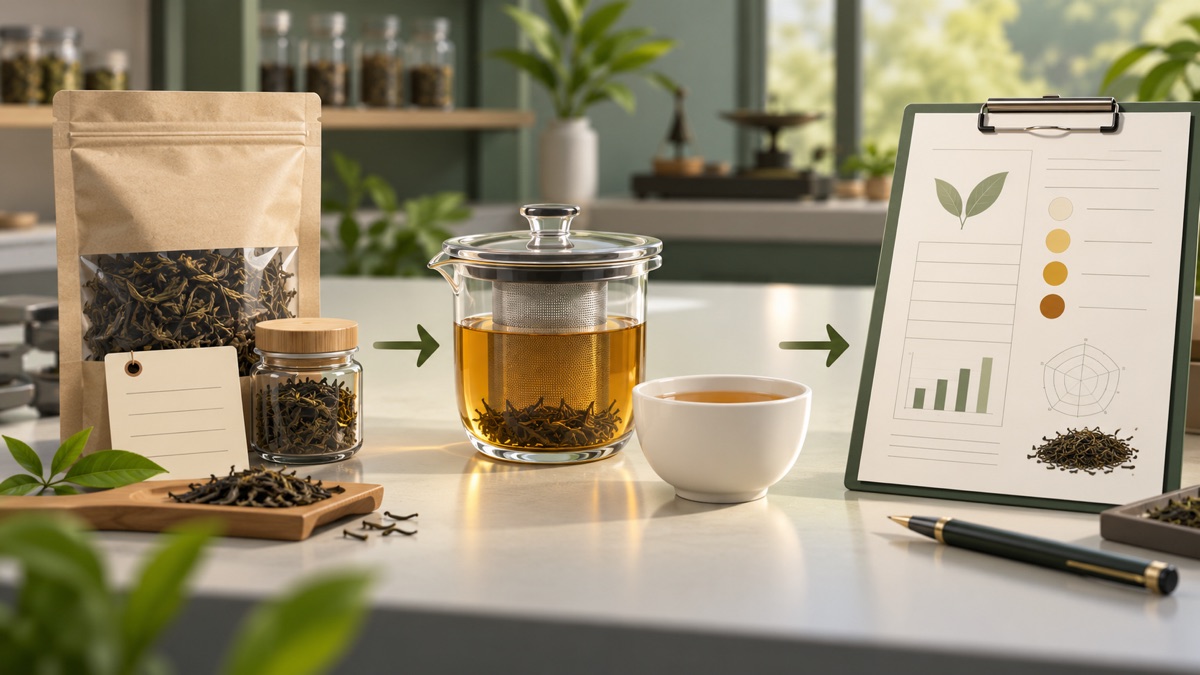
AI-assisted content disclosure: This article was drafted with AI assistance and reviewed against the cited source ledger. The featured visual is an AI-generated editorial illustration.