
Lead: turn a broad “keep it dry” request into a release-ready specification
For a bulk tea buyer, moisture is not merely a warehouse instruction. It is a specification problem that crosses product selection, packaging, transport, receiving, and release. A purchase order that says “low moisture” may still leave the buyer unable to compare lots, decide which test result applies, or investigate a problem after a humid transit leg. A bulk tea water activity specification gives the parties a shared way to define what is measured, when it is measured, and what happens when a result falls outside the agreed acceptance range.
Water activity (aw) and moisture content are related but not interchangeable. FDA technical guidance describes water activity as the relationship between a food’s vapor pressure and that of distilled water at the same conditions; it also notes that equilibrium relative humidity divided by 100 corresponds to aw. In procurement terms, moisture content tells part of the product story, while aw helps describe the availability of water in the finished tea and its relationship with the surrounding environment. Neither number, by itself, proves a tea is safe, authentic, or suitable for every market. The useful buyer question is narrower: can the supplier and buyer reproduce a measurement and use it to control the agreed storage and release risk?
This framework is written for importers, distributors, beverage developers, and private-label teams buying finished loose leaf tea, tea powders, or tea ingredients. It is not a universal regulatory limit and does not replace destination-market requirements, a hazard analysis, or product-specific shelf-life work.
Why moisture percentage alone is not a complete buying control
A moisture result is commonly reported as a percentage by mass. It can be a valuable incoming check, but its meaning depends on sampling, method, product format, and the condition of the material when it was tested. A fine powder, a compressed tea, and a whole-leaf product can respond differently to humidity even if a simple moisture figure appears similar. A water-activity reading is also condition-sensitive: FDA notes that temperature differences around a measurement can alter the reading, so an unqualified result is weak evidence for a buying decision.
That distinction matters when a buyer is comparing pre-shipment results with an arrival sample. An apparent mismatch may reflect a changed lot, a changed test method, an unrepresentative sample, a temperature difference, or genuine moisture pickup. Treating every mismatch as either a supplier failure or a harmless laboratory variance makes corrective action harder. Instead, the release file should preserve enough context to investigate the difference.
The commercial consequence is broader than a single laboratory number. Water activity can affect storage stability, while tea quality can also be influenced by light, oxygen, package integrity, and time. A 2026 peer-reviewed study on matcha found that higher aw and light exposure were associated with progressively lower measured polyphenols, flavonoids, and antioxidant activity under that study’s storage conditions. The study supports the practical need to control humidity and light together for matcha; it does not establish a universal acceptance limit for all tea formats. Buyers should avoid converting one product-specific experiment into a blanket claim for every tea SKU.
Build the specification around the finished, saleable unit
The most useful starting point is the exact material the buyer will receive, not a generic description such as “green tea.” Write the scope so that it identifies the tea type and grade, the lot definition, the agreed pack configuration, and whether the reading applies before or after final packing. If a tea will be repacked, blended, flavored, milled, or used in a beverage base, say so. Each change can alter the relevance of a result taken earlier in the chain.
A practical purchase specification can include the following fields:
- product identity, grade, lot code, crop or production reference where relevant, and net pack configuration;
- the agreed aw acceptance range or maximum, clearly marked as a commercial specification rather than a regulatory claim unless the applicable rule is verified separately;
- the moisture-content method and limit, if moisture is also required;
- the test method, instrument class, calibration or verification approach, sample temperature, and equilibrium conditions to be recorded;
- sampling location, number of packs or increments, sample preparation, retest rule, and retained-sample requirement;
- packaging barrier, closure, desiccant policy if used, light protection, and carton/pallet protection;
- the shipment and receiving conditions that trigger a hold, review, or additional test.
The number should follow product development and validation, not precede it. A buyer can ask a supplier to propose an achievable operating range supported by historical lots, then review it against the intended pack, route, and shelf-life target. For a new private-label format, an agreed range may need a pilot or stability study before it becomes a routine release criterion. This prevents a specification from becoming an arbitrary promise that neither party can sustain.
Design a measurement record that another party can read
Comparable results require more than a device name. A receiving or pre-shipment record should identify the lot, person or laboratory, date and time, product and sample temperature, number of increments, method reference, instrument identifier, calibration or performance-check status, result, and any observation about package condition. If a sample was ground, pooled, or exposed while being prepared, record that too. The aim is not paperwork for its own sake; it is to make a later comparison possible.
Ask one basic question before accepting a certificate: does the sample represent the packed lot being released? A favorable result from a production-line composite may not answer the same question as a result from sealed saleable packs. For high-value powders or climate-sensitive routes, buyers can define a split-sample arrangement: the supplier retains one sealed reference and the buyer receives a separately identified retained sample or a documented sampling plan. The approach should be proportionate to risk and agreed before shipment.
Where a buyer uses both moisture and aw, avoid silently substituting one for the other. Report them as separate fields and state which field controls release. If the supplier reports only moisture, the buyer should not infer a water-activity value. If a laboratory reports aw, it should not be presented as a full microbiological clearance. These boundaries make commercial communication more reliable.
Connect the product result to packaging and transit controls
A laboratory result describes a point in time. The buyer still needs to protect that condition through the journey. The packaging section of the specification should therefore identify the primary barrier and closure, secondary carton condition, pallet or container protection, and instructions for avoiding prolonged exposure during loading or receiving. A photo set at dispatch can document the pack and seal condition, but it is not a substitute for a test or a logistics record.
For matcha and other sensitive powders, light protection belongs in the same review as humidity control. The recent matcha research examined the interaction of water activity and light rather than treating either factor alone. For loose leaf tea, the exact balance may differ, but the procurement principle remains sound: specify the conditions that could change the buyer-relevant attribute, then verify the controls that actually apply to the shipment.
Temperature and relative-humidity loggers can be useful risk evidence on a route, especially for a new lane or a complaint investigation. They do not measure the tea’s aw directly. Their role should be written accurately: they help establish the environmental history that may justify an arrival hold or confirm the need for targeted testing. Do not market a container logger as a product-quality certificate.
Use a hold-and-review decision tree at receiving
An arrival program works best when it says what happens before a shipment arrives. Start with a document review: confirm the lot code, packing list, pre-shipment certificate, sampling record, and packaging description match the purchase order. Then inspect the outer carton, pallet protection, and visible primary packs before opening samples. Record any water damage, broken closure, puncture, odor, visible condensation, or mismatch in lot identity.
A buyer can predefine three outcomes. First, release when identification, documents, packaging, and agreed results align. Second, conditional hold when the lot is identifiable but a discrepancy needs clarification or an agreed confirmatory test. Third, escalated hold when traceability is broken, packaging integrity is materially compromised, or the result cannot be tied to the released lot. The record should separate what was observed from the suspected cause. “Carton damp on arrival” is an observation; “tea absorbed moisture during transit” is a hypothesis requiring evidence.
If a result falls outside an agreed range, do not default to blending, re-drying, or relabeling. First preserve the sample and evidence, notify the responsible parties, and use the agreed retest procedure. Any disposition should follow the buyer’s quality system and applicable law. A commercial specification is not authority to alter a product without the necessary technical and regulatory review.
A concise RFQ checklist for bulk tea buyers
- What exact finished pack and lot does the proposed aw result represent?
- Is the acceptance value a product-specific commercial target, and what evidence supports it?
- Which method, temperature conditions, instrument check, and sample preparation are used?
- Will the report identify sampling points, test date, lot code, and package condition?
- Which result controls release if moisture content and aw are both reported?
- What pack barrier, closure, light protection, and transit safeguards preserve the tested condition?
- What receiving observations trigger a hold, and who authorizes retest or disposition?
Make the first article a working baseline, not a promise
The value of a bulk tea water activity specification is not that it creates one magic number. Its value is that it makes the buyer’s expectation testable across supplier release, shipping, and receipt. A clear lot definition, reproducible record, packaging controls, and hold criteria reduce ambiguity without making unsupported safety or shelf-life promises. Once the baseline is agreed, the next question is how to validate the supplier’s sampling and measurement record; a later supporting guide in this week’s topic cluster will address that evidence pack.
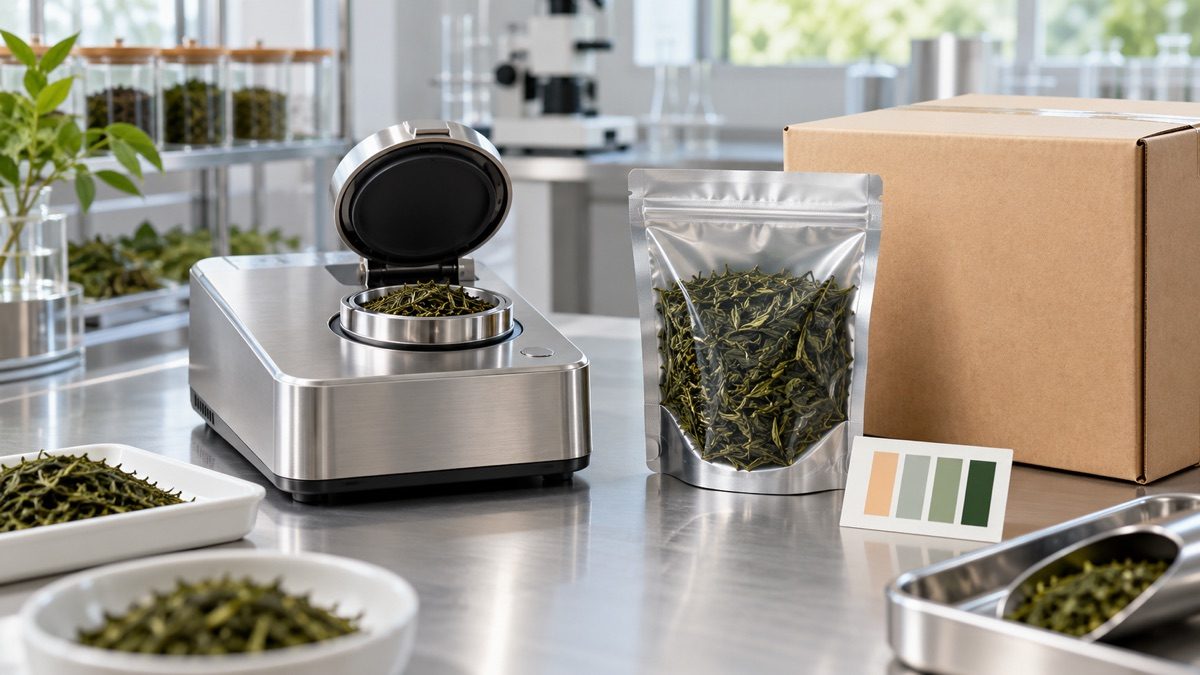
AI-assisted content disclosure: This article was drafted with AI assistance and editorial review. The featured image is an AI-generated editorial illustration; it is not a photograph of a real facility, product test, or shipment.