For an EU-bound tea programme, a packaging brief can no longer stop at pouch size, print finish and barrier preference. The pack, sachet, filter paper, adhesive, ink, overwrap and any coating that can contact the tea form part of the product decision. A buyer does not need to become a packaging chemist, but does need a repeatable way to ask what the food-contact material is, how it is intended to be used, and which version of the supplier’s evidence applies to the final tea SKU.
PFAS has made that conversation more visible, particularly where paper or paperboard is expected to resist moisture, grease or oil. Yet “PFAS-free” is not a useful procurement outcome when it appears as an unsupported sales statement. The stronger outcome is a controlled evidence file: a buyer knows the material structure, intended contact conditions, relevant declarations and test scope, the responsible supplier, and the change-notification route. That framework also helps with other food-contact questions, from inks and adhesives to migration and recyclability claims.
Start with the tea pack’s real contact map
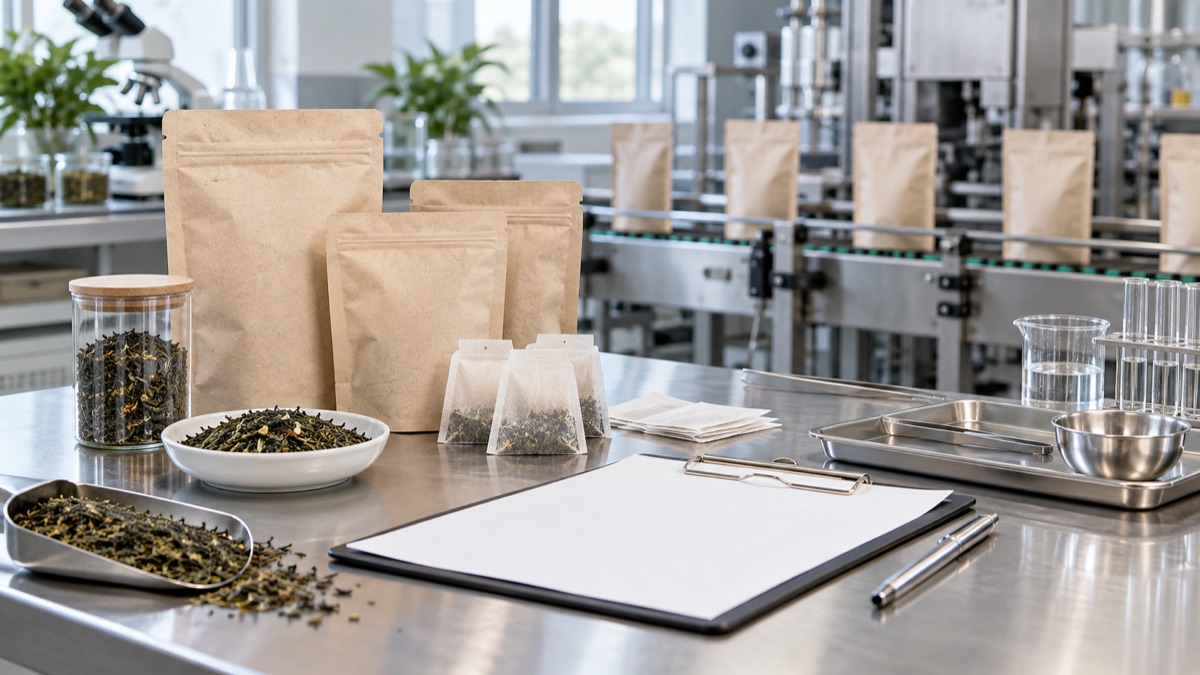
The primary keyword for this buyer task is tea packaging PFAS due diligence. It starts with mapping every component, rather than treating “packaging” as one material. Record the tea-contact surface first: a pyramid sachet, a paper filter, a foil laminate, a lined pouch, or a bulk liner. Then capture secondary components that can affect the finished article: tag string, sealing layer, glue, ink, labels, coating, inner wrap, desiccant placement and outer carton.
For each component, write down the supplier’s material designation, country of manufacture, product code and revision. Add the foreseeable conditions of use: dry loose tea or tea bag; hot-water infusion; storage time; humidity exposure; contact temperature; and whether the pack is single-use or reused. A material that is suitable for one use case should not be silently assumed suitable for another. The European Commission explains that food-contact materials include packaging and that constituents may transfer into food, potentially affecting safety, taste, smell or appearance. That is why a tea buyer’s file needs the use conditions alongside the material name.
Turn “PFAS-free” into answerable supplier questions
Do not ask only, “Is this packaging PFAS-free?” Ask a sequence that links the assertion to the supplied article:
- What is the complete food-contact material construction, including coatings, barriers, inks and adhesives?
- Does the supplier intentionally use fluorinated substances in any layer or processing treatment relevant to this article?
- What declaration, specification or test report supports the answer, and which product code and revision does it name?
- What food type, temperature, contact duration and conversion process does the evidence cover?
- Was the sample or test item representative of the final material, including print and coating configuration?
- Who must notify the buyer if material, coating, mill, converter, ink, adhesive or production site changes?
These questions do not create a legal claim and do not establish that a package is safe for every market. They make it possible to identify an unanswerable claim before artwork is approved. FDA material on PFAS food-contact applications likewise distinguishes intended use, product manufacturing and migration potential. Its current page notes that a broad analytical result such as total fluorine is not, by itself, capable of distinguishing PFAS from other fluorine-containing substances. Buyers should therefore avoid treating a single catch-all test name as a substitute for a defined test method, scope and interpretation.
Build a declaration pack, not a certificate pile
A practical food contact packaging documentation pack has a clear hierarchy. First, retain the product specification and bill of materials for the exact article. Second, request a supplier declaration that identifies the article, revision and intended use. Third, retain supporting test reports only where their sample, method and conditions are relevant to the buyer’s use. Fourth, preserve certificates such as quality-system certificates as context, not as a replacement for product-specific evidence.
The buyer should be able to open the file six months later and answer three basic questions without inference: what was purchased; what use was approved; and what evidence supported the approval. The European Commission’s food-contact materials guidance states that all such materials must comply with the applicable framework and be manufactured under good manufacturing practices. That supports a disciplined records approach, but it does not mean a buyer may assume compliance from a generic logo or a supplier’s marketing page.
For a private label tea launch, connect the packaging record to the artwork approval. A pack can change after the tea itself has passed sensory and residue checks: a new printer, revised varnish, different adhesive, a replacement paper mill or a new sachet converter may all create a new document-review event. Give every approved packaging configuration a revision identifier that appears on the purchase order, artwork proof and finished-goods release packet.
Separate regulatory review from commercial preference
“PFAS-free” can be a commercial preference, a customer requirement, a restricted-substance condition or a market-specific legal assertion. These are not interchangeable. The buyer’s sourcing brief should say which one is being requested, which destination market applies, and who owns the final regulatory review. Avoid placing unqualified “safe,” “non-toxic,” “compliant everywhere” or “zero PFAS” claims on retail copy merely because a supplier has completed a questionnaire.
The German Federal Institute for Risk Assessment describes food-contact materials as materials that should not release substances under normal or foreseeable use in ways that endanger health or unacceptably change food composition or organoleptic properties. It also points to material-specific guidance and test methods. For procurement, the lesson is operational: document the actual use case and ensure the technical and regulatory teams assess the evidence for the market in scope. This article is a sourcing framework, not legal or toxicological advice.
Use a four-gate approval flow before tea packing begins
Gate 1: brief. Define the tea format, destination, contact conditions, required commercial claims and the components in scope. Do this before requesting quotations, so suppliers respond to the same requirements.
Gate 2: evidence. Compare the supplier’s declaration, specification and any supporting test information to the exact construction. Flag missing product codes, expired revisions, unscoped reports and unexplained differences between sample and production material.
Gate 3: sample and artwork. Confirm that the physical sample, artwork proof and material revision match. The goal is not to perform a laboratory analysis at the buyer’s desk; it is to prevent a different unreviewed material from entering a signed-off SKU.
Gate 4: release and change control. Before production, place the approved packaging revision in the purchase order. At release, match it to the batch documentation. Require notice and buyer review before a material, supplier, converter, coating, print system or manufacturing site is changed.
A buyer checklist for tea sachets, pouches and bulk liners
- List each food-contact component and the contact conditions.
- Request an exact product specification and controlled declaration for each article.
- Ask focused questions about intentionally used fluorinated treatments where the application makes that relevant.
- Check whether evidence names the same product code, construction and revision as the quotation and sample.
- Record scope limits; do not translate a test or declaration into a broader claim.
- Assign a destination-market regulatory owner before making packaging claims.
- Link material revisions to artwork approval, purchase orders and release records.
- Require prior notification for component, supplier, process or site changes.
What good evidence changes for a tea buyer
Good due diligence does not promise that paperwork eliminates every food-safety risk. It gives a tea buyer a sharper basis for comparison before converting packaging at scale. It makes a supplier’s answer testable, reveals when a preference has not yet become a product-specific requirement, and creates a documented route for re-review when conditions change.
For a distributor, beverage brand or private label team, that is the useful result: packaging questions move upstream, ahead of printed stock and finished-goods inventory. The resulting file can support more consistent supplier conversations while leaving legal interpretation, laboratory testing and market-specific claim approval to the qualified people responsible for them.
AI-assisted content disclosure: This editorial article was drafted with AI assistance and independently reviewed against the source ledger. The featured image is an AI-generated editorial illustration. It is not a photograph of a real factory, test, certificate or packaging approval.