
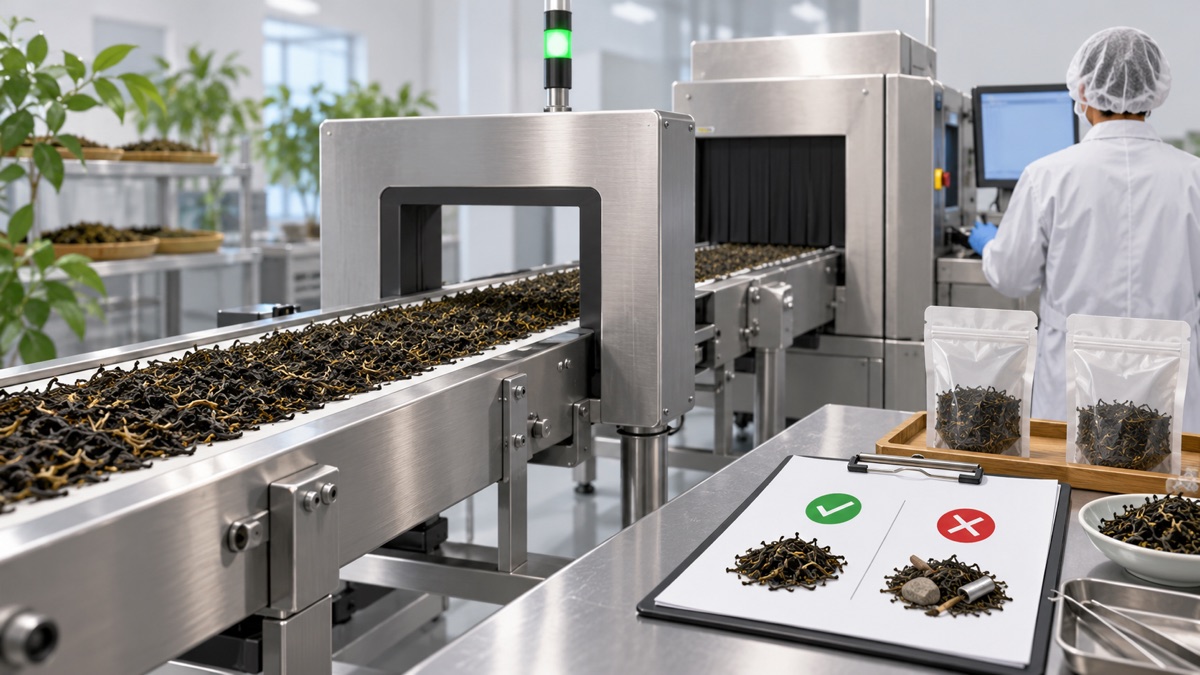
A metal detector, an X-ray unit or a screen can be a useful part of a bulk-tea control programme. None is, by itself, proof that an ordered lot is fit for release. For an importer, beverage brand, distributor or private-label buyer, the practical question is narrower: can the supplier show that the selected check was configured, challenged, recorded and linked to the tea and lot being bought?
Primary keyword: tea foreign material detection validation. This article gives B2B buyers a validation-file structure for dry loose-leaf tea, tea cuts and blends. It does not prescribe a universal setting, acceptance limit or inspection technology. Those decisions depend on the product, process, intended use and applicable market requirements.
Why an equipment name is not a validation record
“Metal detection installed” says little about a shipment. A buyer still needs to know what product passed through the unit, where the unit sits in the process, what material categories it is intended to identify, and how an exception is contained. The same principle applies to screens, magnets, visual sorting and imaging systems: each method has a particular role and a particular boundary.
FDA’s guidance on hard or sharp foreign objects shows why context matters. It considers object size, preparation and intended consumer use; it does not offer a universal specification for every food contract. For tea, a product-specific brief is more useful than an unsupported “foreign-object-free” promise.
Current U.S. preventive-control rules likewise frame the work as written, appropriate controls that significantly minimize or prevent hazards requiring a control. The rule lists process, sanitation and supply-chain controls among the relevant categories. Buyers outside the United States may not be operating under that rule, but its logic is still useful: start with the foreseeable hazard and process, then ask for evidence that the chosen control fits both.
Start with a tea-specific detection brief
Before requesting a “test certificate,” put these facts in the RFQ or technical agreement. They prevent the supplier from returning a generic equipment statement that cannot be matched to the ordered lot.
- Product identity: tea type, grade or cut, blend constituents, moisture condition where relevant, pack route and exact lot definition.
- Material concern: distinguish metal from glass, stone, dense non-metallic debris, plant debris and packaging fragments. A control for one category is not evidence for every category.
- Process position: state whether the check is before blending, after blending, before packing, after packing or at another named step. Identify whether subsequent handling can change the result.
- Intended use: describe whether the material goes to retail packing, tea bags, extraction, foodservice or another downstream process. Do not assume a later step eliminates the relevant risk.
- Decision right: name who may place a lot on hold, investigate an exception and authorize final disposition.
This brief does not tell the supplier which machine to buy. It tells both parties what the evidence must relate to. That is a healthier procurement approach than treating a detector model or a marketing phrase as a safety conclusion.
What a buyer should ask the supplier to demonstrate
The first requirement is a clear scope statement. Ask the supplier to identify the control point, the tea formats that actually pass through it, the material categories it is intended to address and known limitations. For example, a magnet is not interchangeable with a metal detector, and a metal detector does not establish control of glass or all non-metallic debris. An equipment list without that distinction can make a release file sound stronger than it is.
Also ask how the operating condition is checked and what happens when a check rejects product or a verification fails. The record should identify the procedure, date, line, product or lot reference, outcome and any deviation. The exception path should define the hold boundary, investigation owner, review of potentially affected material and disposition authority.
Build a validation pack, not a stack of unrelated certificates
A usable tea detector validation pack can be concise. Its value lies in traceability across the process, not in page count. Ask for the following elements and reconcile them to the purchase order before shipment release.
- Approved product/control matrix: the tea format, line or process step, intended control and stated limitations.
- Procedure reference: the current document identifier and effective date for the relevant operating and verification procedure.
- Run or lot evidence: date, product or lot reference, control-point identity, result, reviewer and any linked exception number.
- Exception record: hold action, investigation conclusion, disposition and release authority where an event occurred.
- Change record: notice of changes to relevant equipment, line position, process flow, product format or co-packer that could make prior evidence inapplicable.
- Shipment match: a final check that the lot, quantity, packing date and shipping documents match the evidence reviewed.
Keep this pack separate from unrelated product claims. A sensory approval, caffeine result, origin statement or clean-looking sample can be valuable for its own decision, but none automatically validates foreign-material detection. Conversely, a detector record does not establish flavour consistency, legal-market compliance or shelf life. Clear boundaries make the buyer’s release decision more defensible.
Use technology claims carefully
New inspection technologies deserve careful evaluation, not automatic rejection or acceptance. A 2025 peer-reviewed review of hyperspectral imaging for food foreign-matter detection describes its potential to provide multi-wavelength information, while also identifying system cost, size and practical data challenges. That is a useful reminder for buyers: technology may add a layer of evidence, but its deployment, product fit and response plan still matter.
Receiving and change-control checks for the buyer
At receipt, a buyer does not need to repeat the supplier’s entire programme. The receiving team can confirm lot identity, outer-pack and liner condition, seals where applicable, visible contamination, document completeness and any mismatch between shipment records and the agreed validation pack. A discrepancy should place the affected material in a defined hold status pending documented review; a quick visual check cannot certify the complete lot.
Before the next shipment, require notice of relevant changes: a new production line, modified detection point, altered screen or cleaning step, change in blend composition, different co-packer, or revised pack route. The buyer can then decide whether prior evidence remains applicable or needs review.
Buyer checklist: tea foreign material detection validation
- Does the file name the exact tea format, lot definition and downstream use?
- Does each claimed control say what it is designed to detect and what it does not cover?
- Can the supplier link the procedure and run evidence to the ordered lot and control point?
- Is there a documented hold, investigation and release path for an exception?
- Have equipment, process, packing and shipment changes been checked for relevance?
- Do receiving observations and shipping records match the evidence pack?
The goal is not a zero-risk slogan. It is a transparent, product-specific record that lets a B2B buyer understand what was checked, why the check applies and what happens if it does not. That makes a detector or inspection method part of a credible tea foreign-material control programme rather than a stand-alone procurement claim.
AI-assisted content disclosure: This article was drafted with AI assistance and independently reviewed against the documented source ledger before publication. It is general procurement information, not legal, regulatory or food-safety advice.