Lead: make a caffeine result answer the same question every time
A tea infusion test brief is the document that makes one caffeine result comparable with another. It tells a supplier, laboratory and buyer which tea was tested, how it was brewed, which liquid was analysed and which serving the result is meant to represent. Without those fields, two reports can both be accurate yet answer different commercial questions.
This matters for importers, private label teams and beverage developers. A dry-leaf result can help manage lots. A brewed-cup result can inform a preparation-specific discussion. A concentrate result may be relevant only after an agreed dilution. None should be copied across those uses without checking the sample and protocol. This is a practical buyer brief, not a universal target or labelling advice.
Why a common infusion brief is worth the effort
Public guidance from the US Food and Drug Administration notes that caffeine amounts can vary among specific products and container sizes. That is a useful warning against treating a tea name or a generic category average as a product specification. The same guidance also notes that decaffeinated tea is not necessarily caffeine-free. For a buyer, the commercial implication is simple: a number needs an identified product, unit and preparation basis before it can be compared, reused or discussed in public wording.
Independent analytical research gives the same practical signal. A 2025 study of tea infusions prepared at 80 C and 100 C for 2, 5 and 10 minutes found that the investigated brewing conditions and serving forms influenced measured caffeine. The study is not a benchmark for every supplier’s tea, and its values should not be copied into an RFQ. It does show why a report that omits time, temperature or tea form is difficult to compare with another report.
Start by writing the decision question
Before sampling, write one sentence that states the decision. Examples include: “Compare two loose-leaf candidates under our intended café preparation,” “Confirm the caffeine basis for a tea-bag serving concept,” or “Evaluate an extract after the agreed beverage dilution.” This prevents a laboratory from receiving a sample with no shared definition of success.
Keep the question narrow. A caffeine test does not establish flavour consistency, microbiological suitability, shelf life, regulatory compliance or a health claim. If those questions matter, they need their own evidence and acceptance criteria. Separating them helps buyers avoid turning one laboratory report into an implied all-purpose approval.
The seven fields of a comparable tea infusion test brief
- Product identity and lot. State the supplier, product code, lot or sample reference, sample date and packaging. A development sample should not silently stand in for a later production lot.
- Tea form and mass. Record whether the sample is loose leaf, a tea bag, a powder, an extract or another form. For an infusion, state the weighed mass or the number and declared fill weight of bags.
- Water and vessel. Specify water volume, any agreed water condition, vessel type and whether the final liquid volume is measured. A starting volume is not always the volume ultimately served.
- Temperature and contact time. State the target temperature, how it is checked, start point for timing and steep duration. If a cold process is relevant, define it separately rather than treating a hot brew as a proxy.
- Agitation and separation. Note stirring, shaking or no agitation, plus how leaves or bags are removed. These operational details can change the practical test even when the tea name is unchanged.
- Analytical request. Ask the laboratory to confirm that the method suits the submitted matrix and to report the unit, method reference, reporting limit and relevant limitations. The buyer should not invent a method name or assume that all results have the same basis.
- Use of the result. Name whether the report is for supplier comparison, internal formulation work, a serving calculation or another defined purpose. If public product wording is contemplated, flag that as a separate review step.
Set the reporting basis before comparing results
Milligrams per gram of dry material, milligrams per litre of infusion and milligrams per serving are not interchangeable labels. They describe different objects. A serving calculation also depends on the actual serving volume and recipe. For example, converting a liquid result into milligrams per serving is arithmetic only when the result represents the finished liquid and the serving volume is known. It does not validate a label, create a recommended intake or prove that another preparation will behave the same way.
Use a shared reporting template for every candidate. Place the product code, lot, preparation protocol, reporting unit and calculation basis on the same page as the result. If one supplier reports an infusion and another reports dry leaf, mark the comparison as incomplete until the team agrees on an appropriate common basis. Do not force a conversion by adding assumptions that were never tested.
Sampling: preserve the link from bag to report
The test brief should travel with the sample. Record who packed it, when it was collected, how it was labelled and whether it was retained. On receipt, check that the laboratory’s sample description matches the buyer’s reference. Resolve a changed product code, unmatched lot or missing preparation instruction before relying on the report.
For buyer comparisons, send all candidate teas through the same written protocol where feasible. This does not make different teas identical; it makes the comparison question visible. When a supplier proposes a different preparation because the product is intended for a different format, record that distinction rather than blending results into one table.
How to review the finished report
A useful review meeting asks five questions: Is this the intended product and lot? Was the agreed infusion protocol followed? What unit and liquid basis are reported? Does the method and report limitation fit the decision? What remains unknown? A report that cannot answer one of these questions may still be useful evidence, but it should be labelled for its narrower purpose.
Do not describe a result below a reporting limit as proof that no caffeine exists. Do not call a single development sample a permanent production range. If a result will influence a sensitive specification or consumer-facing statement, arrange product- and market-specific professional review instead of treating this procurement brief as legal or analytical approval.
Buyer handoff checklist
- Attach the lot-linked sample reference and the complete infusion protocol.
- State tea form, tea mass, water volume, temperature, time and final liquid basis.
- Ask for the analytical unit, method reference and report limitations.
- Keep a serving calculation separate from the measured laboratory result.
- Record whether the report supports comparison, formulation work or a further review.
- Repeat or revise the brief when the tea form, lot, filling weight, extraction, dilution or serving changes.
Used this way, a tea infusion test brief does not promise a universal caffeine figure. It gives buyer and supplier teams a reproducible way to ask the same question, document the answer and see when a new question requires fresh evidence.
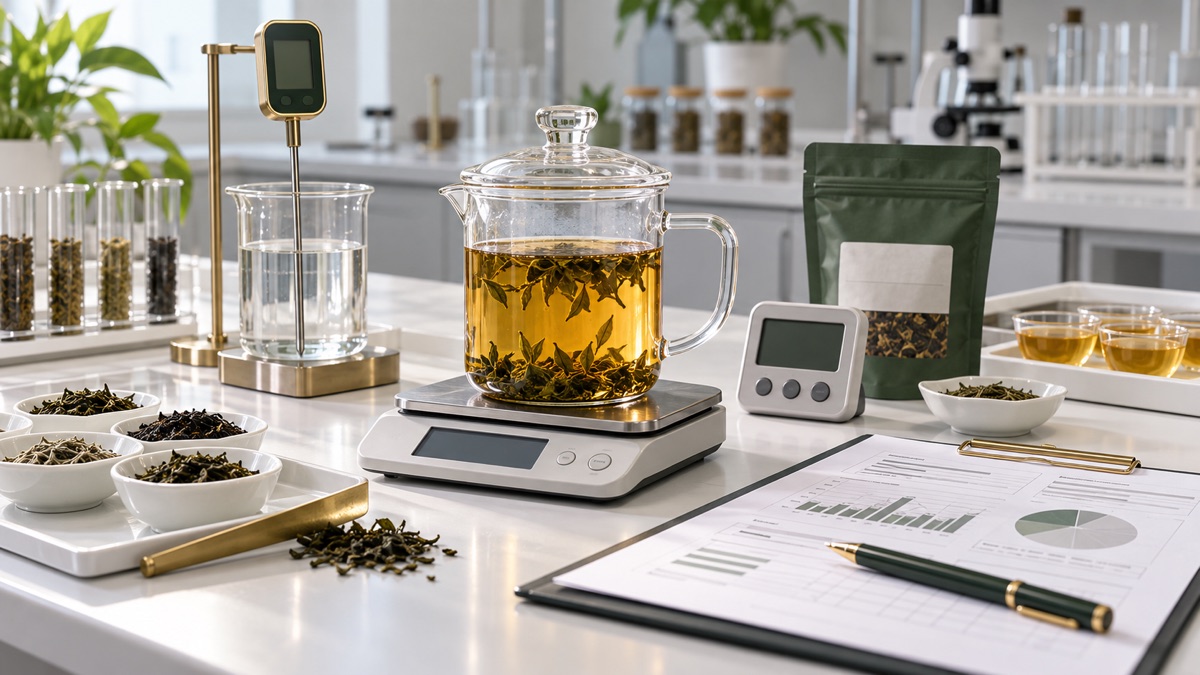
AI-assisted content disclosure: This article was prepared with AI assistance and editorial review. The accompanying image is an AI-generated editorial illustration. Procurement checklists are editorial recommendations; analytical methods, regulatory wording and product decisions require product-specific professional review.