For an EU-bound tea programme, a supplier’s packaging folder is useful only when it lets a buyer answer a production question quickly: does this exact pouch, sachet, liner or overwrap match the version that was reviewed for this tea SKU? A collection of generic certificates cannot answer that question. The practical control is a tea packaging documentation checklist that travels from quotation through sample approval, purchase order and finished-goods release.
This is the operational companion to our Tea Packaging PFAS Due Diligence evidence framework. That overview explains why a component-level evidence file matters. This article focuses on how a B2B buyer, distributor or private-label team can keep the file aligned with the item that is actually ordered. It is a procurement workflow, not legal or toxicological advice.
Why the document file must follow the physical article
Food-contact materials are not limited to a tea pouch’s visible outer layer. Depending on the format, the relevant article can include a paper filter, pyramid sachet, sealing layer, inner pouch, laminate, bulk liner, coating, adhesive, ink or overwrap. The European Commission treats packaging as food-contact material, and its guidance makes intended use and good manufacturing practice part of the context. For a buyer, that means a supplier statement has value only when it identifies the particular construction and the conditions it is meant to cover.
Start the file with a simple article identity card. Record the supplier and converter; material and product code; revision or issue date; component construction; country or site of manufacture where supplied; tea format; destination market; and foreseeable contact conditions. Describe whether the article contains dry loose leaf tea, a tea bag intended for hot-water infusion, or another defined format. Add the approved artwork revision and a photo or sample reference. This record does not prove compliance by itself. It prevents a file for one article from being silently reused for another.
The minimum tea packaging documentation checklist
Ask suppliers for a controlled set of documents, not an undefined request for “all certificates.” The precise legal documents and review depth depend on the market and material, but a buyer’s core file commonly needs the following:
- Product specification: the exact article, layer or component; material description; dimensions; product code; and revision.
- Intended-use statement: the food type, contact duration and temperature assumptions, plus any conversion or sealing conditions that affect the article.
- Supplier declaration: a dated, article-specific statement that connects the construction and intended use to the supplier’s applicable assessment.
- Supporting evidence where relevant: reports or technical information whose sample, method, scope and conclusion are traceable to the supplied material.
- Change-control contact: the named route for advance notice if the mill, converter, coating, ink, adhesive, formulation, manufacturing site or material construction changes.
Keep quality-system certificates in the folder as supplier context, but do not treat them as a substitute for product-specific information. A broad logo, a marketing phrase, or a report naming a different grade does not establish that the production article matches the reviewed one. This distinction matters especially when a buyer asks about fluorinated treatments or makes a commercial PFAS preference part of the brief.
Match each document to the same revision
The highest-value check is a comparison, not a request. Put the quotation, sample label, specification, declaration, artwork proof and purchase order side by side. The product code, layer description and revision should resolve to the same approved article. If a supplier uses its own internal code, capture the buyer’s SKU and the supplier code in the same control table.
When there is a mismatch, treat it as an open question rather than a defect to explain away. A changed paper grade may affect a coating; a new printer may introduce a different ink system; a revised pouch structure may alter the original evidence scope. The FDA’s current food-contact PFAS material explains why a broad result such as total fluorine cannot, on its own, identify PFAS versus all other fluorine-containing substances. The procurement lesson is modest but important: do not convert a single test label into a broader product claim. Request scope, method and the relation to the exact article, then route interpretation to the qualified technical or regulatory owner.
Use four handoff points before production release
1. RFQ handoff. Put the expected pack format, market, contact conditions and claim restrictions in the quotation brief. If a customer requests a material preference, write it as a defined requirement with an evidence expectation, not a vague “safe packaging” request.
2. Sample handoff. Label the physical sample with the material revision. Check that the documents refer to it before sensory samples or artwork approval create momentum around an unreviewed construction.
3. Purchase-order handoff. Place the approved product code and revision on the PO or attachment. Keep the evidence file accessible to the buyer, quality team and packaging owner; do not rely on an inbox thread as the only record.
4. Production-release handoff. Before packing begins, compare the supplied material’s labels or batch documentation to the approved identity card. If the article has changed, pause the document comparison and decide whether review is needed. A change is not automatically unsafe, but it should not inherit prior approval without a traceable assessment.
Separate commercial wording from evidence and market review
“PFAS-free,” “non-toxic,” “food-safe,” and similar phrases can carry different meanings in a sourcing brief, a customer specification and retail copy. Do not let a procurement questionnaire become an unqualified consumer-facing claim. The German Federal Institute for Risk Assessment explains that food-contact materials should not release substances under normal or foreseeable use in ways that endanger health or unacceptably alter food composition or organoleptic properties. It also notes the role of material-specific guidance and test methods. That supports documenting use conditions and evidence scope; it does not create a universal claim for every destination market.
Assign one owner for market-specific review of claims and one owner for the technical evidence file. The buyer can then distinguish three statuses: evidence received, evidence matched to the article, and market claim approved. Keeping those statuses separate is clearer for suppliers and safer for brand teams.
A release-ready buyer control table
A compact table is often enough to prevent confusion. Use one row per food-contact component and include: buyer SKU; supplier product code; revision; material description; intended use; document date; evidence status; sample/artwork match; PO reference; change-notice requirement; and review owner. Mark gaps as “open,” rather than filling them with assumptions. This gives purchasing a clear escalation path before printed stock or finished goods are committed.
The strongest outcome is not a larger certificate pile. It is a file that a new buyer can reopen and understand: what article was approved, why its evidence was relevant, who reviewed it, and what must trigger another look. For tea sachets, pouches and bulk liners, that traceability makes packaging due diligence repeatable without overstating what the documents prove.
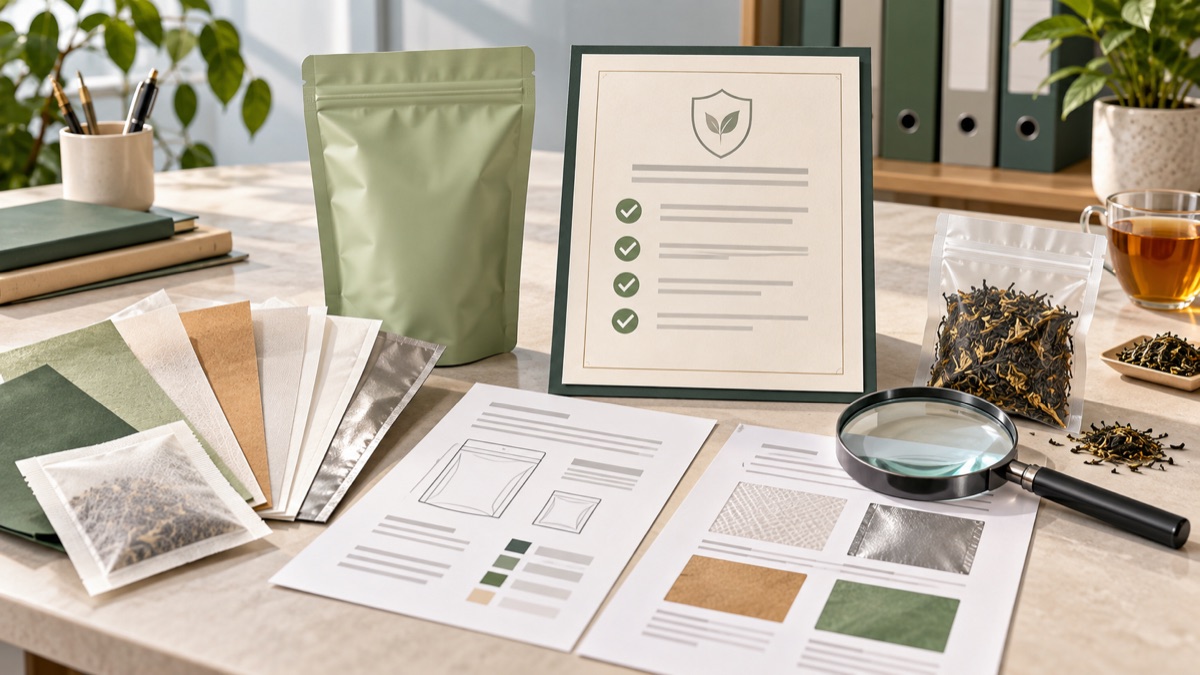
AI-assisted content disclosure: This editorial article was drafted with AI assistance and independently reviewed against the source ledger. The featured image is an AI-generated editorial illustration. It is not a photograph of a real factory, test, certificate or packaging approval.